
About USF Tampa General Physicians

Together, we are providing advanced care to this region’s patients and families

The University of South Florida and Tampa General Hospital began an enhanced affiliation in July 2020, launching a new framework for providing advanced care to the region’s patients and their families. The effort will forge a brighter future together to become Florida’s leading academic medical center, and will serve our communities across all missions, including patient care, teaching, research, and community outreach. This enhanced affiliation includes two major components:

  • It is a comprehensive and sustainable affiliation that promotes coordinated and strategic planning, investment, and joint accountability across both organizations’ shared clinical, research, and teaching efforts.
  • The new organization will provide a unified management and support structure for physicians employed by USF Health and by TGH (through Tampa General Medical Group), which will allow for more coordinated care and consistent performance standards.

Following a year of planning and coordination, the full transition to this new organization launched in October 2021.

Learn more about how USF Health and Tampa General Hospital are working together to create this region’s best and only academic medical center.

Leadership
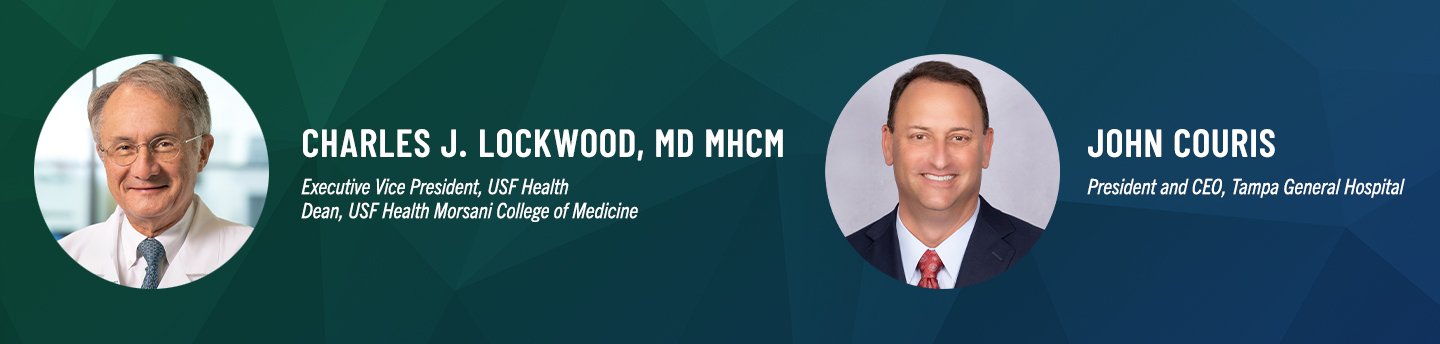
Charles Lockwood MD and CEO John Couris  

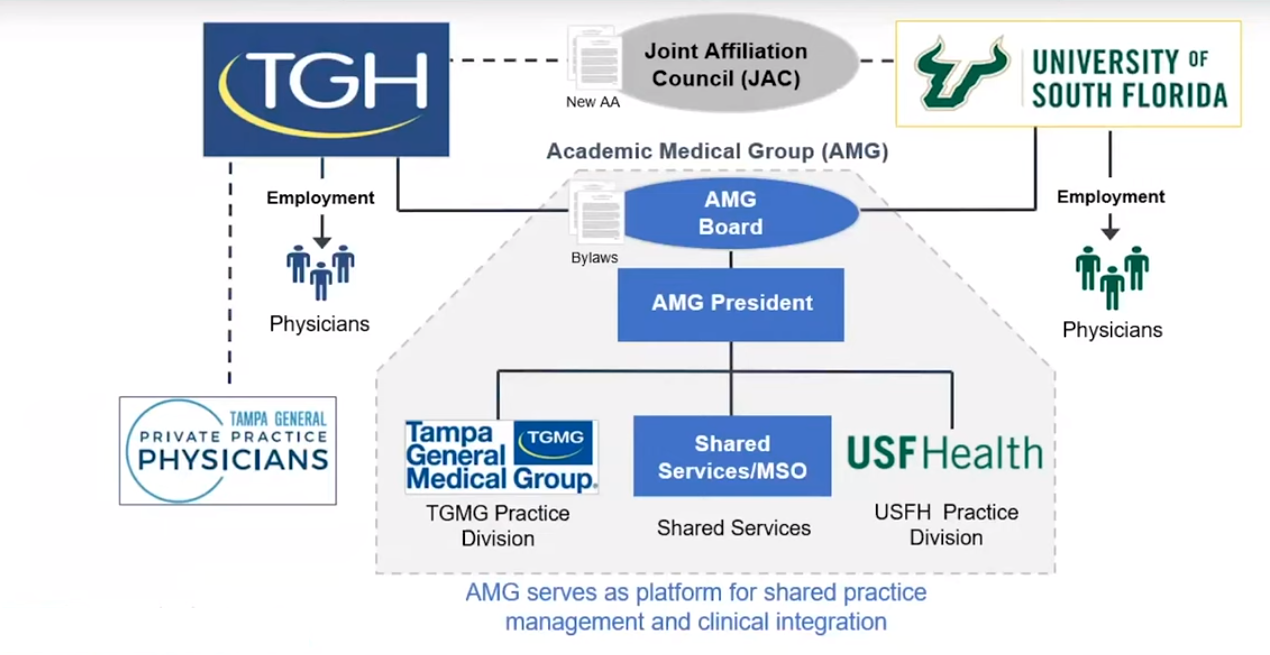
The new organization is a nonprofit organization jointly governed by the University of South Florida and Tampa General Hospital. The enhanced affiliation is not a merger: USF and TGH retain separate governance structures and financial controls.

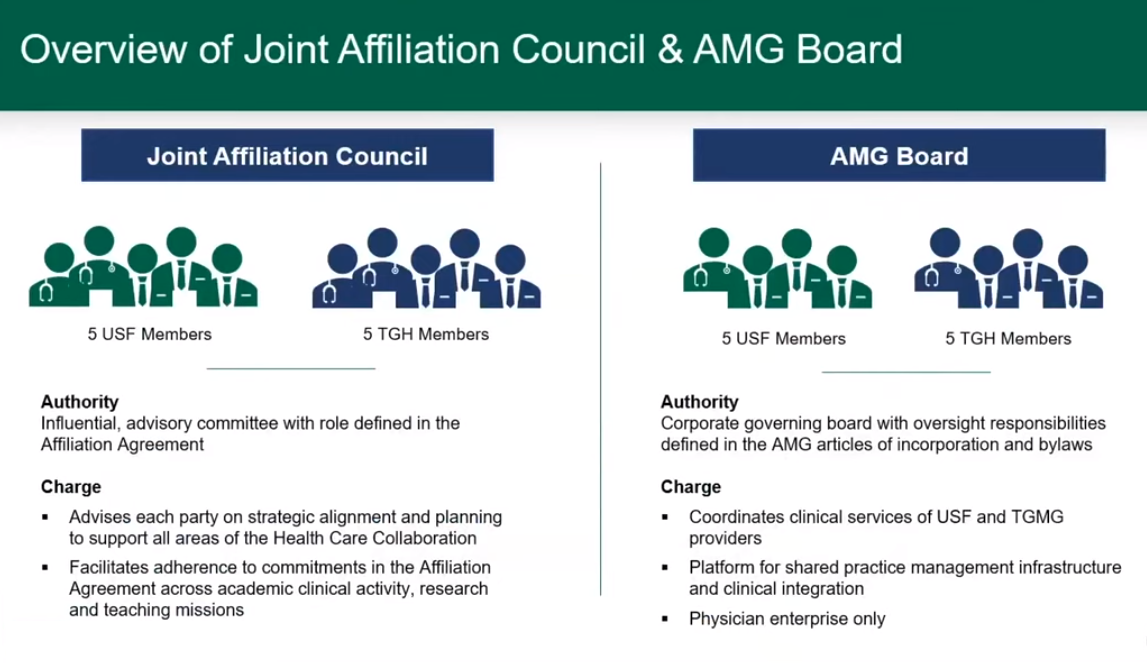
A joint affiliation council comprised of USF and TGH leadership has been formed to serve as an advisory committee that helps to align strategic planning, identify development and expansion opportunities, coordinate joint research and medical education programs, and integrate clinical services through the new USF Health and Tampa General Hospital enhanced affiliation.
Charles Lockwood MD and CEO John Couris  

Why this matters

Academic medical centers combine teaching, research and clinical care to deliver the best possible outcomes to the communities they serve.

The USF Health Morsani College of Medicine and Tampa General Hospital have long been a cornerstone for this region by providing the specialized and innovative care found in academic medicine.

Through this enhanced affiliation, USF Health and TGH will continue their push to provide the most advanced patient care, and aim to elevate both institutions, along with the new organization, to become a true academic health system that cares for patients and their families throughout Florida.

Key reasons why academic medicine in Tampa Bay matters

Patients benefit with access to an academic medical center
Patients are drawn to academic medical centers, where health care professionals are being trained, specialized care is provided, and innovative research takes place. The new organization will bolster this endeavor in the region.

Research drives patient care
Academic medical centers bring a unique set of capabilities as part of their research/academic enterprise, offering a true ‘bench to bedside’ pathway for the newest treatments, procedures and cures, and positively impact clinical quality and patient safety.

Both TGH and the USF Health Morsani College of Medicine have built strong programs for innovative translational and clinical research. The new organization will contribute to furthering these efforts and will help elevate a national reputation for successfully coordinating, collaborating and implementing a regional hub for significant, high-impact research.

Academic medical centers elevate quality
A strong academic affiliation can serve as a powerful differentiating factor that creates value for a health system. All hospitals ranked on U.S. News & World Report’s Honor Roll maintain primary academic affiliations. And the Association of American Medical Colleges reports that 7 out of 10 patients believe teaching hospitals provide added value for patients relative to non-teaching hospitals.

This new organization, USF and TGH can capitalize on being the only academic medical center on the west coast of Florida, which will enhance patient access across key service lines and improve overall financial performance, allowing for reinvestment in the clinical and academic enterprise.

Ability to recruit and retain physicians/faculty
High-caliber physicians/faculty are drawn to academic medical centers where a clinical enterprise is well aligned, physician input is embraced, and there is an opportunity to pursue teaching and research. And organizations experience higher retention rates when university faculty and private practice and hospital employed professionals feel valued, are competitively compensated, and can play a direct role in the performance of the academic medical center.

Both the USF Health Morsani College of Medicine and Tampa General have had great success in attracting high-caliber physicians and researchers. The new organization will only enhance recruiting opportunities.

Success in value-based health care
Value-based arrangements increase efficiencies for organizations, while providing high quality care at lower costs for patients. The new organization will enable USF and TGH to further develop the tools and infrastructure to deliver cost-effective, coordinated, and evidence-based care. Over time, it will also serve as an inviting platform and vehicle to engage private practice physicians and community partners.

Being able to deliver care throughout a comprehensive and broad geographic network throughout West Central Florida will differentiate the value that USF and TGH bring to the community.

Media Contacts

USF Health:
Cody Hawley, PhD
crhawley@usf.edu

Tampa General Hospital:
Karen Barrera
kbarrera@tgh.org

FAQs

What is the vision for the enhanced affiliation?

For USF and TGH to build upon their nearly 50-year affiliation to become Florida’s leading academic medical center (AMC) through a sustainable, collaborative, and comprehensive relationship that mutually benefits each organization, and the communities we serve, across all missions including patient care, teaching, research, and advocacy.

What does it mean to be an academic medical center?

AMCs combine clinical care, research, and teaching to deliver the best possible outcomes, including cutting-edge technologies, resources and therapies to the communities they serve. This is done through the coordinated effort of the academic health system, medical school/university, and faculty/physician organization(s).

What are the major components of the enhanced affiliation?

There are two major components to the enhanced affiliation between USF and TGH:

  • A more comprehensive, global affiliation agreement that promotes coordinated strategic planning, investment, and joint accountability across the parties’ shared clinical, research, and teaching missions.
  • The development of this new organization – a new medical group that includes physicians employed by both UMSA and TGMG.
How is the enhanced affiliation structured?
  • This is not a merger. USF and TGH will retain separate governance structures and financial controls.
  • A joint affiliation council comprised of USF and TGH leadership will be formed to serve as an advisory committee that will help to align strategic planning, identify development and expansion opportunities, coordinate joint research and medical education programs, and integrate clinical services through this new organization.
  • A new financial model that more closely aligns USF and TGH through performance-based funding for integrated clinical services and investment in the academic enterprise.
 
What is this new organization and how will it impact existing providers?
  • The new organization is a nonprofit organization jointly governed by USF and TGH.
  • Through this new organization, USF and TGH will operate their collective physician enterprise – including physicians employed by USF and TGMG – as a clinically integrated medical group (There will be no change in employment for either USF faculty or TGMG physicians.)
  • The new organization will be responsible for establishing business and clinical policies and procedures subject to employment control retained by USF and TGH.
  • The new organization will also provide all practice infrastructure, clinical management, and related operational and administrative support services, including management of employed or leased staff.
  • Over time, The new organization will also serve as an inviting platform and vehicle to engage private practice physicians and community partners (e.g., by offering practice management services or participation in value-based arrangements.)
What are the anticipated benefits of the enhanced affiliation?

Elevated stature and performance as an academic medical center:

  • A strong academic affiliation can serve as a powerful differentiating factor that creates value for a health system. All hospitals ranked on U.S. News & World Report’s Honor Roll maintain primary academic affiliations.
  • Patients are drawn to AMCs where healthcare professionals are being trained, specialized care is provided, and innovative research takes place. The Association of American Medical Colleges reports that 7 out of 10 patients believe teaching hospitals provide added value for patients relative to non-teaching hospitals.
  • TGH and USF can capitalize on being the only AMC on the west coast of Florida in order to enhance access across key service lines and improve overall financial performance, allowing for reinvestment in the clinical and academic enterprise.

Ability to recruit and retain physicians/faculty:

  • High-caliber physicians/faculty are drawn to AMCs where the clinical enterprise is well aligned, physician input is embraced, and there is an opportunity to pursue teaching and research.
  • Organizations where university faculty, private practice and hospital-employed professionals feel valued, are competitively compensated, and can play a direct role in the performance of the AMC experience higher retention rates.
  • Medical education programs that train resident physicians and are aligned with clinical strategies provide a pipeline of physicians and physician leaders.

Integrated physician enterprise that supports high-level performance (i.e., quality, safety, access, productivity):

  • Creation of a clinically integrated physician enterprise, consisting of more than 600 providers under a single management structure allows for a more coordinated approach to care and consistent performance standards.
  • Increases availability of high quality, efficient clinical services in West Central Florida.
  • Consolidates USF and TGMG practice operations and staff to create a single practice management infrastructure.

Success in value-based health care:

  • The new organization will enable USF and TGH to further develop the tools and infrastructure to deliver cost-effective, coordinated, and evidence-based care.
  • Over time, it will also serve as an inviting platform and vehicle to engage private practice physicians and community partners (e.g., by offering practice management services or participation in value-based arrangements).
    • Value-based arrangements increase efficiencies for organizations, while providing high-quality care at lower costs for patients.
  • Being able to deliver care throughout a comprehensive and broad geographic network throughout West Central Florida will differentiate the value that USF and TGH bring to the community.

Research that drives patient care:

  • AMCs bring a unique set of capabilities as part of their research/academic enterprise (e.g., advanced analytics, translational research). Smart investments in these areas can have a direct impact on the clinical enterprise and help to drive overall performance.
  • Innovations in clinical research and population health can be transferred to improvements in clinical quality and patient safety. A shared culture that promotes innovation and encourages learning will have a positive impact on patient care.